Your Cart is Empty


Prices for store pick up
(not including delivery or shipping)
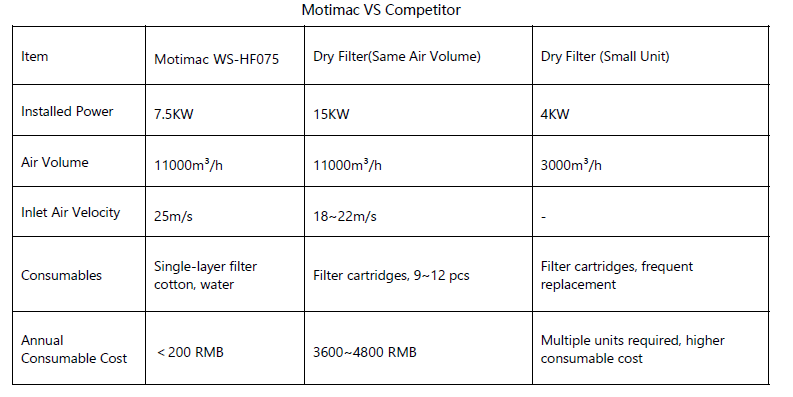
1. 2.75× ultra-high air volume for greatly improved dust filtration performance
Equipped with a 7.5kW motor, delivers a rated air volume of 11,000 m³/h.
Conventional wet filters on the market are generally fitted with a 5.5kW motor, offering an
air volume of only 4,000 m³/h.
2. Approximately 96% reduction in consumable cost
The annual consumable cost is less than 200 RMB. It only requires a single layer of filter
cotton replacement plus minor water replenishment loss at a rate of around 10 L/h.
A dry filter with same air volume requires complete replacement of filter cartridges every
year. For a unit equipped with 12 filter cartridges
3. Annual power saving of 16,800 kWh
A dry filter with same air volume consumes an extra 7.5 kW × 8 h = 60 kWh per day. Based
on 280 operating days per year, the annual extra power consumption reaches 60 kWh ×
280 days = 16,800 kWh. The difference in electricity cost is remarkable over long-term
operation.
Operation & Maintenance
WS - HF075: Equipped with automatic detection and fault alarm functions. It eliminates
manual periodic logging and experience-based inspection, achieving nearly
maintenance-free operation.
Dry Filter: It requires regular manual inspection and dust cleaning. Operators must
judge filter cartridge clogging based on experience. Delayed maintenance may lead to
reduced suction, excessive emissions and other issues, resulting in high labor
management costs.
Our finance partners can arrange funding to acquire equipment at competitive rates. We can offer loan, lease and hire purchase agreements to suit our customers needs.
*****We have a handy leasing calculator available on request help identify the monthly costings and tax savings*******
The Tax Benefits of Leasing explained
Leasing converts a large capital expenditure into small monthly payments. Hence the company has the profit-making equipment immediately and keeps their cash reserve available.
Rather than investing the precious cash reserves in depreciating assets, the company can use them to help increase profits.
Lease Rental is 100% Tax deductible
The main reason that the majority of companies lease rather than purchase equipment is that they use leasing as a method of reducing their tax bills. This is because lease rental is 100% tax deductible, and all payments made for the equipment are written off against the company’s tax bill. For any profit making business, this means a substantial saving in the real cost of acquiring equipment by lease rental. This could mean a saving of between 20-40% of the lease payments, depending on the rate of tax you pay*.
Payments on qualifying leases are written off as direct operating expenses, rather than a debt or outstanding liability, thus reducing short term taxable income.
Any capital allowances are passed on to you, and lease payments can be offset against taxable profits. VAT can also be reclaimed on monthly payments. This status as a “lease” as opposed to a “liability” on a company’s balance sheet is something the banks like to see, which is why an operating lease can be attractive. For this reason, leasing is often referred to as ‘off balance sheet’ financing – a tremendous advantage to both large and small businesses
Ownership at the end of the lease
Lease rental is just that, a rental or hire agreement. Title of the goods remains with the Lessor (either Kennet or assigned to a bank), which means the equipment does not show on the companies balance sheet, therefore not needing to be depreciated over a fixed period. If Kennet broker the funding, they are the “third party” involved within the lease agreements. In effect, Kennet buys the equipment from the supplier and then sell it on to the customer. This means that the customer can take full advantage of all the benefits of leasing but still owns it at the end.
The disadvantage of buying equipment outright
The disadvantage to buying equipment out-right, is that the capital invested becomes a depreciating asset. This is an asset that’s value decreases over time.
The total amount that assets have depreciated by during a reporting period is shown on the cashflow statement, and also makes up part of the expenses shown on the income statement. The amount that assets have depreciated to by the end date is shown on the balance sheet.
***************************************************************************************************************************
How the tax advantages of leasing works – in numbers
You lease a machine that costs £5,000 + VAT, over a 3 year term.
The monthly payments would be £162.50 + VAT over 36 months
Total paid over the term of the lease £5850
20% tax can be reclaimed on the total lease payments over the 3 years, so a total of £1170
Therefore the net cost of the lease is £5850 – £1170 = £4680*
***************************************************************************************************************************
*Your accountant will be able to provide more information. This information is provided for guidance only.
For more information, call Mark Suckley and his team at Kennet Equipment Leasing on 01675 469215 or email marksteam@kennet-leasing.co.uk.
All prices are quoted EXWORKS Bacup. You can arrange your own collection or if preferred we can arrange delivery.
We have Transport partners with a variety of vehicles including HIAB. Please enquire for a quotation.
Collections: Metal Finishing Machinery
Category: Metal Grinding and Deburing
Please send us your enquiries via the following email form.